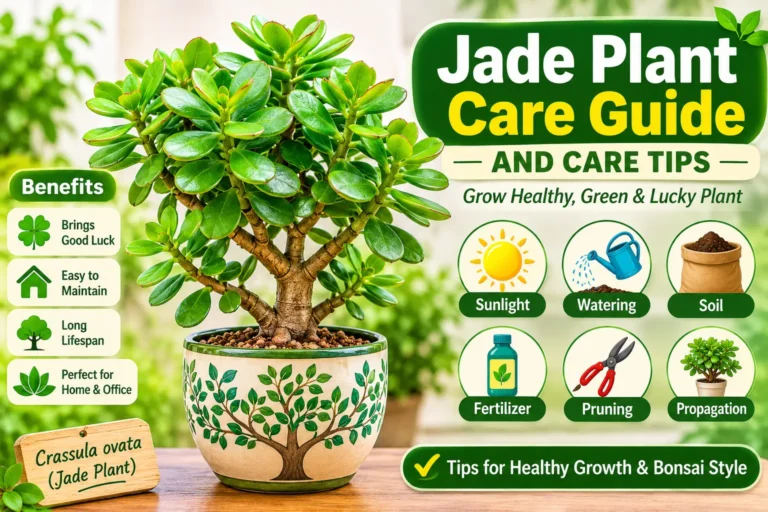
Jade Plant and Elephant Bush are two beautiful succulent plants that are often confused with each other because of their similar appearance, thick green leaves, and woody stems. Both are popular among succulent enthusiasts, indoor gardeners, and bonsai lovers.
However, despite their similarities, they are two different plant species with distinct botanical characteristics, growth habits, and care requirements.
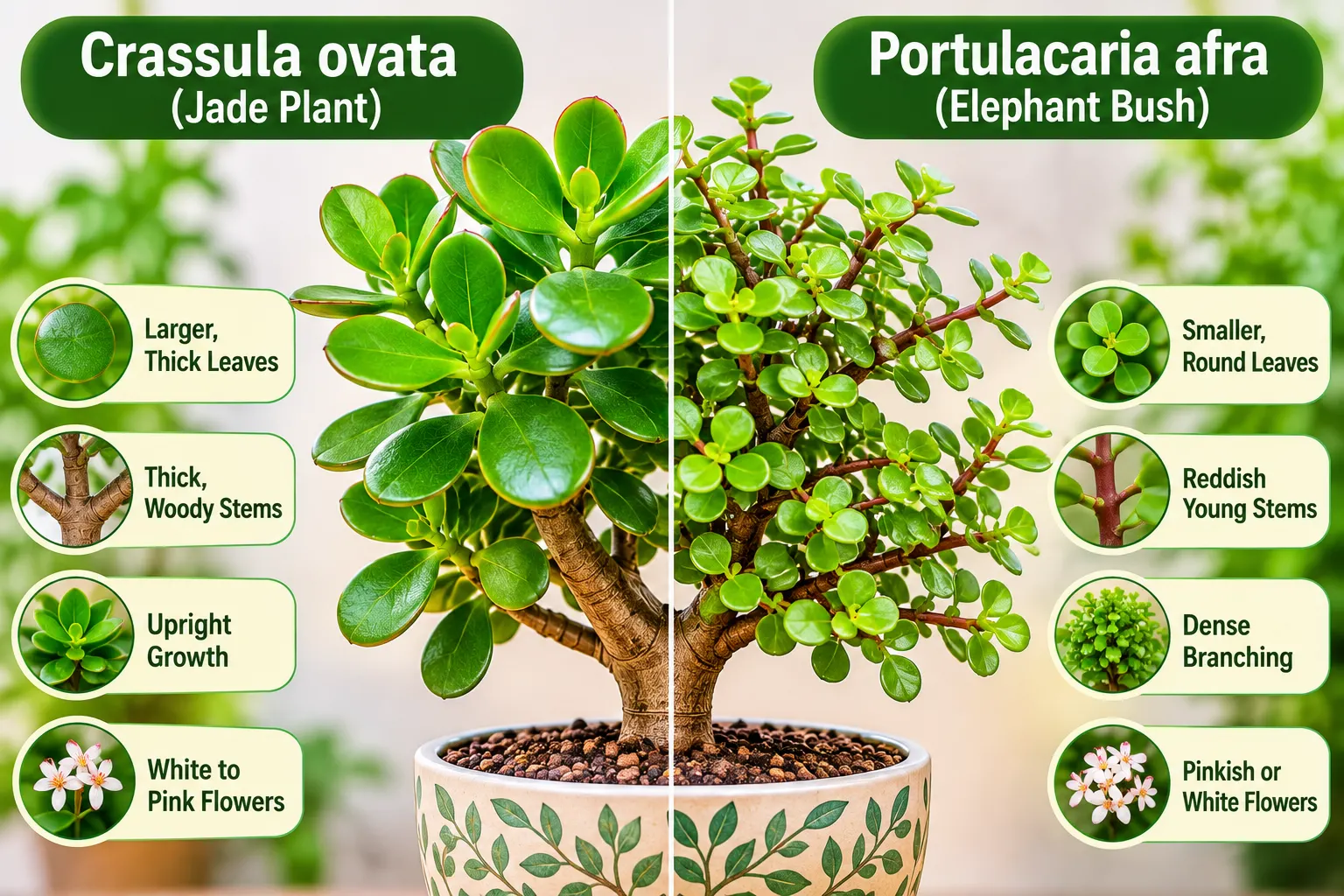
The Jade Plant (Crassula ovata), commonly known as the True Jade Plant or Money Plant, is recognised for its thick, fleshy, oval-shaped leaves and sturdy woody trunk. On the other hand, the Elephant Bush (Portulacaria afra), often called Dwarf Jade, Miniature Jade, or Spekboom, has smaller rounded leaves, reddish young stems, and a naturally dense branching structure.
Understanding the difference between these two plants is important when purchasing, growing, propagating, or training them as bonsai.
In this complete comparison guide, we will explore their botanical differences, leaf characteristics, stems, growth rates, sunlight requirements, watering needs, propagation methods, bonsai potential, and overall maintenance to help you identify and choose the right plant.
1. What Is the Jade Plant (Crassula ovata)?
The Jade Plant, scientifically known as Crassula ovata, is an evergreen succulent shrub native to South Africa and Mozambique.
It belongs to the Crassulaceae family and is widely grown as an ornamental plant because of its attractive, fleshy green leaves and thick woody stems.
The plant naturally develops a tree-like structure as it matures. Its branches become thicker, and its leaves may develop attractive reddish edges when exposed to suitable sunlight.
Because of its attractive appearance and traditional association with wealth and prosperity, the Jade Plant is commonly grown in homes, offices, balconies, and gardens.
Key Characteristics of Jade Plant
- Botanical Name: Crassula ovata
- Common Names: Jade Plant, True Jade, Money Plant, Friendship Tree
- Family: Crassulaceae
- Native Region: South Africa and Mozambique
- Plant Type: Evergreen succulent shrub
- Leaf Shape: Thick, oval, fleshy leaves
- Stem: Thick, sturdy, and woody when mature
- Growth Habit: Upright and branching
- Water Requirement: Low
- Sunlight: Bright light and some direct sunlight
- Propagation: Leaf and stem cuttings
The True Jade Plant is particularly appreciated for its ability to develop a thick trunk and attractive tree-like appearance over time.
2. What Is Elephant Bush (Portulacaria afra)?
Elephant Bush, scientifically known as Portulacaria afra, is a succulent shrub native to South Africa.
It is commonly known as Dwarf Jade, Miniature Jade, Small Leaf Jade, Elephant Plant, and Spekboom.
Although it resembles the True Jade Plant, Elephant Bush belongs to a different botanical family, Didiereaceae, under modern classification.
It is characterised by small, rounded, fleshy green leaves attached to reddish young stems. As the plant matures, its stems develop a woody appearance and greyish bark.
Elephant Bush is particularly popular for bonsai cultivation because it produces dense branching and relatively small foliage.
Key Characteristics of Elephant Bush
- Botanical Name: Portulacaria afra
- Common Names: Elephant Bush, Dwarf Jade, Miniature Jade, Spekboom
- Family: Didiereaceae
- Native Region: South Africa
- Plant Type: Evergreen succulent shrub
- Leaf Shape: Small, rounded, fleshy leaves
- Stem: Reddish when young, woody when mature
- Growth Habit: Dense and branching
- Water Requirement: Low
- Sunlight: Bright light to full sun
- Propagation: Primarily stem cuttings
Elephant Bush is an excellent choice for people interested in compact succulent plants, miniature trees, and decorative bonsai arrangements.
3. Jade Plant vs Elephant Bush: Main Differences
The most important difference between these plants is their botanical identity. They belong to separate genera and plant families, even though they are commonly sold under similar names.
Complete Comparison Table
| Characteristics | Jade Plant | Elephant Bush |
|---|---|---|
| Botanical Name | Crassula ovata | Portulacaria afra |
| Common Name | True Jade Plant | Dwarf Jade |
| Family | Crassulaceae | Didiereaceae |
| Origin | South Africa and Mozambique | South Africa |
| Leaf Shape | Oval and fleshy | Small and rounded |
| Leaf Size | Relatively large | Relatively small |
| Leaf Thickness | Thick and succulent | Fleshy but generally thinner |
| Stem Colour | Green when young | Often reddish when young |
| Mature Bark | Brownish and woody | Greyish and woody |
| Growth Habit | Upright and sturdy | Dense and spreading |
| Growth Rate | Generally slower | Generally faster |
| Sunlight | Bright light and direct sun | Bright light and direct sun |
| Water Requirement | Low | Low |
| Soil | Well-draining succulent mix | Well-draining succulent mix |
| Propagation | Leaves and stems | Primarily stems |
| Pruning | Occasional | Frequent shaping possible |
| Bonsai Suitability | Excellent | Excellent |
| Maintenance | Low | Low |
| Flower Colour | White or pale pink | Pinkish or white |
| Common Uses | Indoor decoration and bonsai | Bonsai, succulent gardens and decoration |
Important identification point: Elephant Bush is not a botanical variety of Crassula ovata. It is a separate species. The name Dwarf Jade is a common trade name, not its scientific classification.
4. Difference in Leaves: How to Identify Both Plants
Leaf structure is one of the easiest ways to distinguish Jade Plant from Elephant Bush.
Jade Plant Leaves (Crassula ovata)
The True Jade Plant has relatively large, thick, oval-shaped leaves.
Its leaves are usually glossy green and may develop reddish margins under suitable light conditions.
Characteristics:
- Oval or egg-shaped appearance.
- Thick and fleshy texture.
- Relatively broad leaves.
- Often reddish edges under bright sunlight.
- Leaves commonly clustered near the ends of branches.
Elephant Bush Leaves (Portulacaria afra)
Elephant Bush has smaller, rounded or oval leaves arranged closely along its branches.
Its leaves are generally smaller and less thick than those of the True Jade Plant.
Characteristics:
- Small, rounded or oval shape.
- Fleshy but comparatively thinner leaves.
- Closely arranged along the stems.
- Bright to dark green foliage.
- Compact appearance.
Identification tip: If the plant has relatively large, thick oval leaves, it is more likely to be Crassula ovata. If it has small, closely arranged rounded leaves and reddish young stems, it is more likely to be Portulacaria afra.
5. Difference in Stems and Trunk Structure
The stems and trunk provide another useful way to identify these plants.
Jade Plant Stem
Crassula ovata develops thick, sturdy stems that gradually become woody with age.
Mature plants can develop impressive trunks with rough, textured bark and strong branches.
Its natural structure makes it attractive for growing as a miniature tree.
Elephant Bush Stem
Portulacaria afra generally develops thinner and more flexible branches.
Young stems are often reddish or reddish-brown, while older stems become greyish and woody.
Its ability to produce numerous branches makes it particularly suitable for compact bonsai designs.
6. Which Plant Grows Faster?
Elephant Bush generally grows faster than the True Jade Plant under favourable growing conditions.
| Growth Characteristic | Jade Plant | Elephant Bush |
|---|---|---|
| Growth Speed | Slow to moderate | Moderate to relatively fast |
| Branch Development | Gradual | Often faster |
| Trunk Development | Gradual | Can develop with regular cultivation |
| Leaf Production | Periodic new growth | Often frequent during active growth |
| Pruning Response | Good | Generally very responsive |
Elephant Bush can produce dense foliage and new branches relatively quickly when provided with adequate sunlight, warmth, and proper watering.
Jade Plant usually requires more patience to develop a substantial trunk and mature branching structure.
Actual growth depends on the plant’s age, cultivar, container size, climate, and growing conditions.
7. Sunlight Requirements: Which Plant Needs More Sunlight?
Both plants prefer bright growing conditions and can benefit from direct sunlight.
Jade Plant Sunlight Requirements
Crassula ovata performs well with several hours of sunlight, especially gentle morning sunlight.
It can also tolerate bright indirect light, although insufficient light may cause weak, elongated growth.
Elephant Bush Sunlight Requirements
Portulacaria afra also grows well in bright light and full sun after gradual acclimatisation.
Adequate sunlight encourages compact foliage and stronger branching.
Sunlight Comparison
| Light Condition | Jade Plant | Elephant Bush |
|---|---|---|
| Bright Indirect Light | Suitable | Suitable |
| Morning Sunlight | Excellent | Excellent |
| Afternoon Sunlight | Gradual acclimatisation needed | Gradual acclimatisation needed |
| Low Light | Not ideal | Not ideal |
| Full Sun | Suitable after acclimatisation | Suitable after acclimatisation |
For Indian conditions, protect newly purchased or indoor-grown plants from sudden exposure to intense afternoon sunlight, particularly during summer.
8. Watering Requirements: Jade Plant vs Elephant Bush
Both plants are drought-tolerant succulents. They store water in their leaves and stems and do not require frequent watering.
However, their actual watering needs depend on the growing environment.
Jade Plant Watering
- Allow the potting mix to dry completely before watering again.
- Water thoroughly rather than giving small amounts frequently.
- Avoid keeping the roots continuously wet.
- Reduce watering during cool and humid weather.
Elephant Bush Watering
- Allow the growing medium to dry between watering.
- Water thoroughly when the soil is dry.
- Avoid excessive moisture around the roots.
- Reduce watering during rainy and cooler periods.
Watering Comparison
| Factor | Jade Plant | Elephant Bush |
|---|---|---|
| Water Requirement | Low | Low |
| Drought Tolerance | High | High |
| Overwatering Sensitivity | High | High |
| Watering Method | Thorough watering after soil dries | Thorough watering after soil dries |
| Main Risk | Root and stem rot | Root and stem rot |
Important: Neither plant should be watered according to a fixed calendar alone. Always check the soil before watering.
9. Soil Requirements
Both plants require loose, well-draining soil to maintain healthy roots.
A heavy soil mixture that remains wet for long periods can cause root rot.
Recommended Soil Mix for Both Plants
You can prepare a suitable growing medium using:
- 1 part quality potting soil.
- 1 part coarse sand or horticultural grit.
- 1 part perlite or pumice.
A commercial cactus and succulent potting mix is also suitable.
Use pots with drainage holes and avoid containers that retain excessive moisture.
10. Fertilizer Requirements
Both plants require relatively little fertilizer compared with many flowering and foliage plants.
During active growth, occasional feeding with a diluted balanced liquid fertilizer can support healthy development.
| Fertilizer Requirement | Jade Plant | Elephant Bush |
|---|---|---|
| Fertilizer Type | Balanced succulent fertilizer | Balanced succulent fertilizer |
| Feeding Season | Spring and summer | Spring and summer |
| Frequency | Every 6–8 weeks approximately | Every 4–8 weeks approximately |
| Winter Feeding | Usually unnecessary | Usually unnecessary |
Always follow the fertilizer manufacturer’s instructions and avoid overfeeding.
Elephant Bush may require more frequent feeding when it is being actively pruned to develop dense foliage, but fertilizer requirements should be based on actual growth and soil conditions.
11. Which Plant Is Better for Bonsai?
Both Crassula ovata and Portulacaria afra are excellent plants for bonsai-style cultivation.
However, their different growth characteristics make them suitable for slightly different bonsai styles.
Jade Plant Bonsai (Crassula ovata)
Jade Plant is particularly attractive for developing miniature trees with:
- Thick woody trunks.
- Strong primary branches.
- Broad, fleshy foliage.
- Sculptural tree-like structures.
- Mature-looking forms.
Its slower growth means developing a large trunk and refined structure requires patience.
Elephant Bush Bonsai (Portulacaria afra)
Elephant Bush is particularly useful for developing:
- Dense branching.
- Compact miniature trees.
- Fine branch structures.
- Smaller foliage proportions.
- Informal upright and spreading bonsai styles.
It responds well to regular pruning and can produce new shoots from suitable pruning points.
Bonsai Comparison
| Bonsai Feature | Jade Plant | Elephant Bush |
|---|---|---|
| Thick Trunk | Excellent potential | Good potential |
| Small Foliage | Less suitable for very small scales | Excellent |
| Dense Branching | Good | Excellent |
| Pruning Response | Good | Very good |
| Fine Branching | Moderate | Very good |
| Trunk Development | Gradual | Generally faster |
| Bonsai Styling | Excellent | Excellent |
Bonsai recommendation: Choose Crassula ovata for a substantial, thick-trunked succulent bonsai. Choose Portulacaria afra if you prefer smaller foliage, dense branching, and compact miniature tree designs.
Both plants have brittle or succulent branches, so aggressive wiring should be avoided. Pruning and gradual shaping are often more suitable.
12. Propagation: How to Grow New Plants
Both plants can be propagated through stem cuttings, making them relatively easy to multiply.
Jade Plant Propagation
Crassula ovata can be propagated through both leaf and stem cuttings.
Stem cutting method:
- Select a healthy branch.
- Cut a suitable section using clean scissors.
- Allow the cut surface to dry and form a callus.
- Place the cutting in a well-draining succulent mixture.
- Keep it in bright indirect light.
- Begin watering carefully as roots establish.
Leaf cutting method:
A healthy leaf can also produce roots and new growth when its base remains intact. However, this method generally takes longer than stem propagation.
Elephant Bush Propagation
Portulacaria afra is commonly propagated through stem cuttings.
- Select a healthy, mature stem.
- Cut a section using clean pruning scissors.
- Remove the lower leaves.
- Allow the cut end to dry for a few days.
- Plant the cutting in a suitable succulent mixture.
- Keep it in a warm, bright location.
- Water cautiously while roots develop.
Stem cuttings generally root readily in favourable warm conditions.
13. Common Problems and Their Solutions
Both plants are relatively hardy, but incorrect watering and insufficient sunlight can affect their health.
| Problem | Possible Cause | Solution |
|---|---|---|
| Yellow Leaves | Excessive watering | Check soil and drainage |
| Wrinkled Leaves | Underwatering or root damage | Inspect soil and roots |
| Falling Leaves | Environmental or watering stress | Maintain stable conditions |
| Soft Stems | Excess moisture and rot | Remove affected portions |
| Weak Growth | Insufficient sunlight | Provide brighter light |
| Leggy Branches | Low light | Gradually increase sunlight |
| Brown Leaf Patches | Sunburn or physical damage | Adjust sunlight exposure |
| Root Rot | Poor drainage | Repot in fresh, well-draining soil |
The best way to prevent most problems is to provide adequate sunlight, good ventilation, and well-draining soil.
14. Are Jade Plant and Elephant Bush Safe for Pets?
Pet safety is another important difference to consider.
Jade Plant: Crassula ovata is considered toxic if ingested by cats and dogs. It may cause vomiting, lethargy, and other symptoms.
Elephant Bush: Its foliage is edible and is consumed in some parts of southern Africa. However, do not assume that every commercially sold specimen is safe for pets, particularly if treated with pesticides or other chemicals.
For homes with pets, identify the plant correctly and keep unfamiliar plants away from animals that may chew them.
15. Jade Plant vs Elephant Bush: Which Is Better for Indian Conditions?
Both plants can grow successfully in India, particularly in areas with warm temperatures and adequate sunlight.
However, their placement and watering should be adjusted according to local weather.
Summer
- Provide sufficient sunlight.
- Protect recently purchased plants from sudden intense heat.
- Avoid watering while the soil is still wet.
- Maintain good air circulation.
Monsoon
- Protect both plants from continuous rainfall.
- Ensure proper drainage.
- Reduce watering because the soil may dry more slowly.
- Watch for stem and root rot.
Winter
- Provide adequate sunlight.
- Reduce watering when growth slows.
- Protect plants from frost and prolonged cold.
- Avoid keeping soil continuously moist.
Both species are best grown in containers with excellent drainage in areas experiencing heavy monsoon rainfall.
16. Which Plant Should You Buy?
The choice depends on your purpose, available growing space, and preferred appearance.
Choose Jade Plant (Crassula ovata) If:
- You prefer large, thick, oval-shaped leaves.
- You want a classic lucky plant.
- You like thick trunks and sturdy branches.
- You want to create a mature-looking succulent bonsai.
- You prefer a slow-growing decorative plant.
Choose Elephant Bush (Portulacaria afra) If:
- You prefer small, rounded leaves.
- You want a compact succulent.
- You enjoy frequent pruning and shaping.
- You want dense bonsai branching.
- You prefer a plant that generally develops new growth more quickly.
Both are beautiful succulents and can be excellent additions to a home garden or bonsai collection.
17. Frequently Asked Questions (FAQs)
Q1. Are Jade Plant and Elephant Bush the same plant?
No. Jade Plant is Crassula ovata, while Elephant Bush is Portulacaria afra. They are separate botanical species belonging to different plant families.
Q2. Why is Elephant Bush called Dwarf Jade?
Elephant Bush resembles the True Jade Plant because both have fleshy green leaves and woody stems. Its smaller foliage has led to common names such as Dwarf Jade and Miniature Jade.
Q3. Which is the real Jade Plant?
The scientifically recognised True Jade Plant is Crassula ovata. Elephant Bush is a different species, despite sometimes being sold as Dwarf Jade.
Q4. How can I identify Jade Plant and Elephant Bush?
Look at their leaves and stems. Crassula ovata has larger, thicker oval leaves and sturdy branches. Portulacaria afra has smaller rounded leaves, closely arranged along its branches, and often reddish young stems.
Q5. Which plant grows faster?
Elephant Bush generally grows faster and produces dense branching more readily under suitable conditions. Jade Plant usually develops more slowly.
Q6. Which is better for bonsai?
Both are excellent bonsai subjects. Elephant Bush is particularly suitable for compact bonsai with fine branching, while Jade Plant is attractive for developing thick trunks and substantial branches.
Q7. Can both plants grow in India?
Yes. Both can grow well in warm Indian conditions when provided with sufficient sunlight, well-draining soil, and controlled watering.
Q8. Can Elephant Bush be grown indoors?
Yes, but it needs plenty of natural light. A bright window or sunny balcony is generally better than a dark indoor corner.
Q9. Can Jade Plant and Elephant Bush grow from leaves?
Yes, but it needs plenty of natural light. A bright window or sunny balcony is generally better than a dark indoor corner.
Q10. Are both plants lucky plants?
Both are associated with prosperity and good fortune in popular gardening and Feng Shui traditions. However, these associations are cultural beliefs rather than scientifically established benefits.
Q11. Can Elephant Bush develop a thick trunk like Jade Plant?
Yes. With sufficient time, good growing conditions, and appropriate cultivation, Elephant Bush can develop a woody trunk. However, its natural branching and trunk characteristics differ from those of Crassula ovata.
Q12. Is Miniature Jade the same as Elephant Bush?
Miniature Jade is a common name for Portulacaria afra. However, some dwarf cultivars of Crassula ovata are also marketed using similar names. Always check the botanical name before purchasing.
18. Final Verdict: Jade Plant vs Elephant Bush
Jade Plant and Elephant Bush may look similar, but they offer different growing characteristics and decorative possibilities.
The True Jade Plant (Crassula ovata) is an excellent choice for people who appreciate thick, fleshy leaves, sturdy woody trunks, and classic succulent bonsai designs.
The Elephant Bush (Portulacaria afra) is ideal for people who prefer smaller foliage, dense branching, and compact miniature trees.
Both plants are drought-tolerant, relatively easy to maintain, and suitable for succulent collections and bonsai cultivation.
The best choice ultimately depends on your preferred appearance and gardening objectives.
Remember: Crassula ovata is the True Jade Plant, while Portulacaria afra is Elephant Bush, commonly known as Dwarf Jade. They are different species, not two varieties of the same plant.
Discover More Plants at MyPlant.in
Whether you are interested in attractive succulents, lucky plants, decorative indoor plants, or bonsai specimens, choosing the correct plant species is the first step towards successful gardening.
Explore the plant collection at MyPlant.in and discover beautiful plants to enhance your home, balcony, garden, and workspace.
MyPlant.in – Bringing Nature Closer to Your Life, One Plant at a Time.